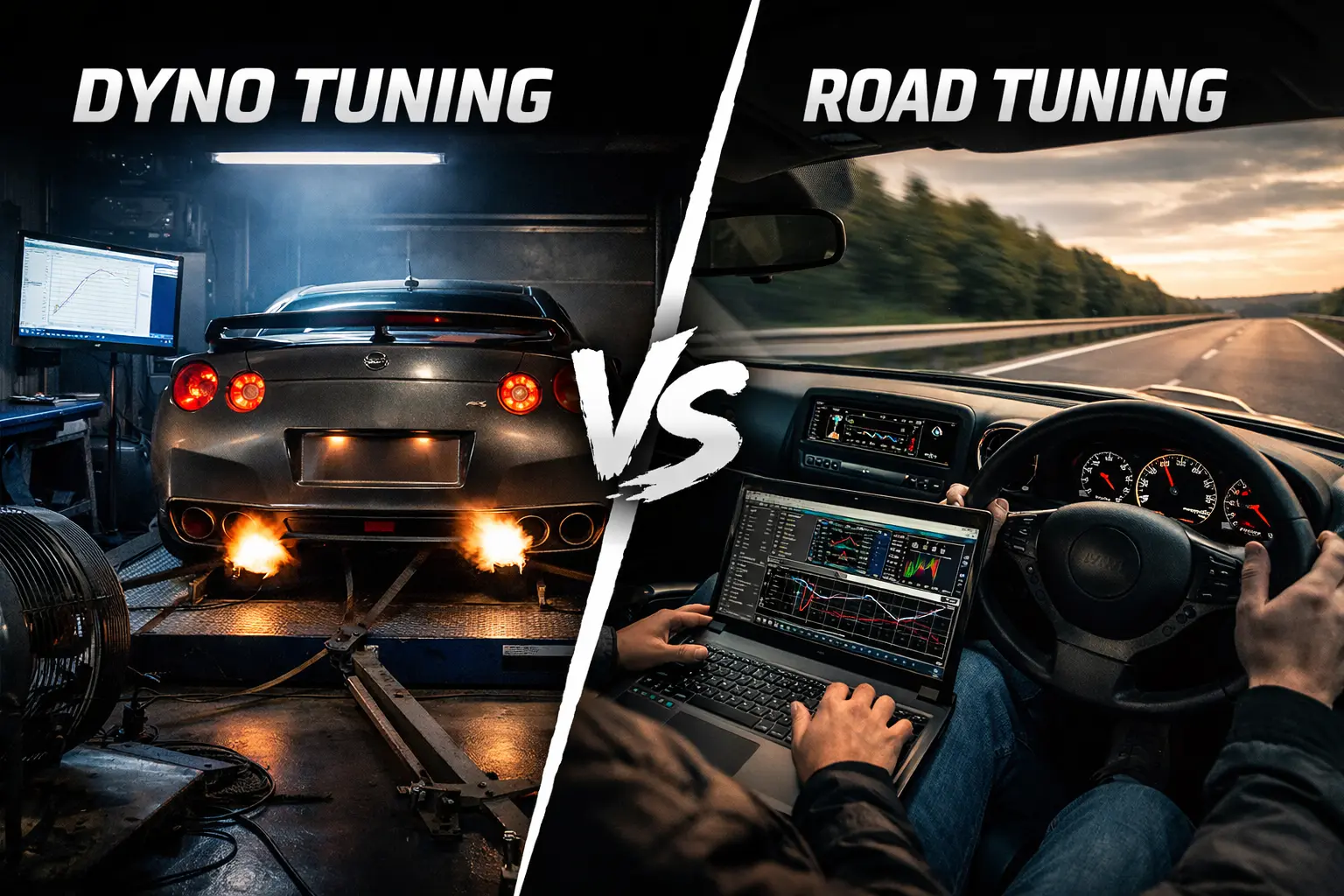
The tune is what makes or breaks a performance build. Here is an honest comparison of dyno tuning versus road tuning.
What is Dyno Tuning?
Dyno tuning involves calibrating the engine management system while the car is strapped to a dynamometer, applying controlled load while measuring power, torque, air-fuel ratio, and other parameters in real time. It provides a controlled, repeatable environment.
What is Road Tuning?
Road tuning calibrates the engine while driving. The tuner uses data logging during pulls, then makes adjustments between runs. It has the advantage of real driving conditions but lacks repeatability.
Comparison
| Dyno Tuning | Road Tuning | |
| Repeatability | Excellent | Variable |
| Safety | Engine monitored at all times | Higher risk at high power |
| Precision | Can hold exact load/RPM points | Transient only |
| Real-world accuracy | May need road validation | Tuned in actual conditions |
| Data quality | Full load, steady-state | Transient only |
Why Dyno Tuning Matters
For serious performance builds, the ability to hold specific load and RPM points while monitoring all parameters allows the tuner to optimise every cell in the fuel and ignition maps. This is critical at high power levels where the margin between optimal performance and engine damage is narrow.
The BB Motorsport Approach
We use our 2WD and 4WD dyno as the primary tuning tool, combined with road and track validation. MaxxECU’s advanced data logging (up to 1000Hz on GEN1, 1600+ channels on GEN2) gives us surgical precision. We offer dyno runs starting from R475.
Book a dyno session: 060 991 9840 | View our services