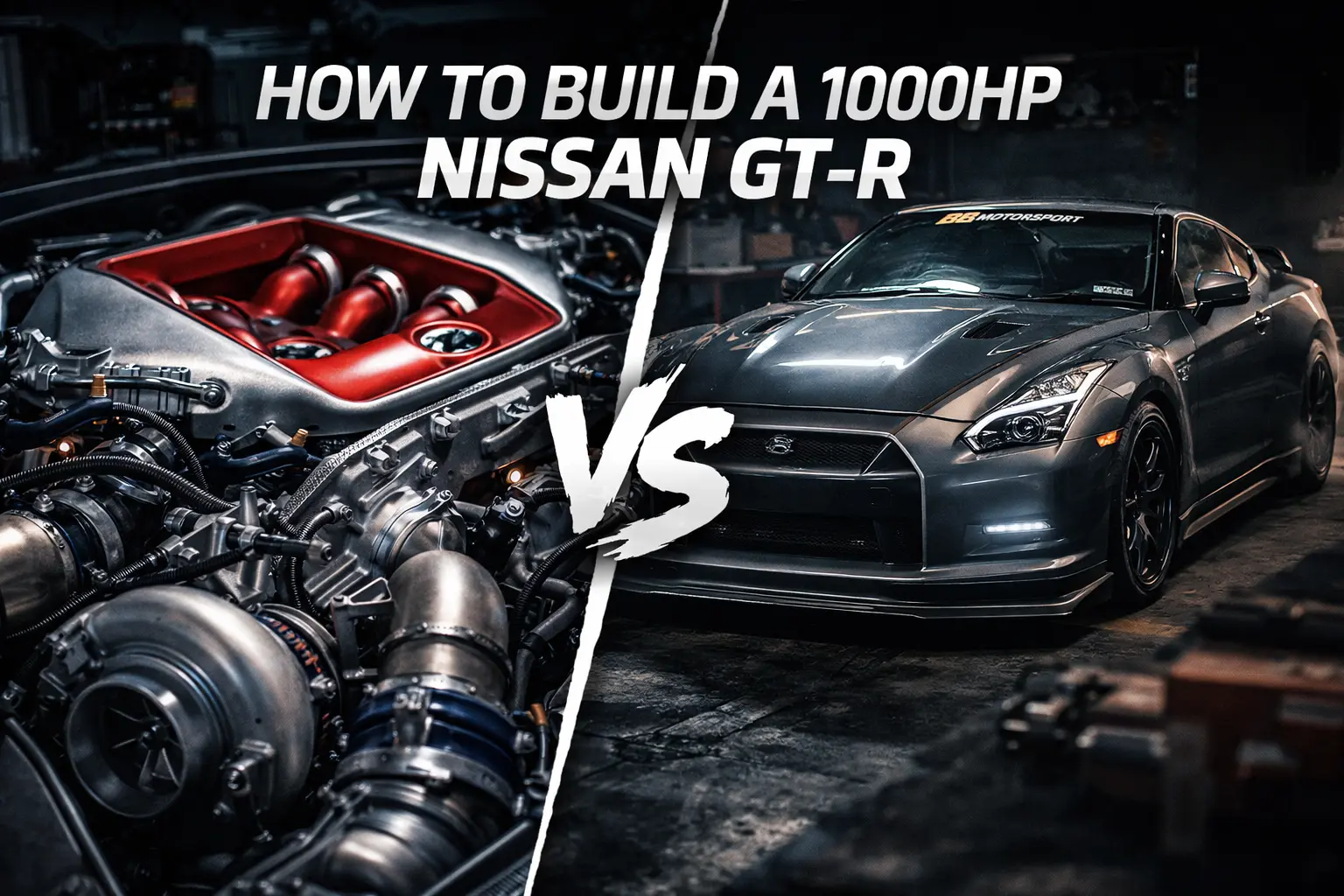
Building a 1000 horsepower Nissan GT-R is a serious engineering project. Here is a realistic breakdown of what is involved.
Engine Internals
The stock VR38DETT is remarkably strong, but at 1000hp the factory internals are at their limit. A reliable build requires forged pistons, forged connecting rods, and often a billet crankshaft. Head studs replace factory bolts to ensure the gasket seal holds under extreme cylinder pressure.
Turbo Systems
The factory turbochargers are spent well before 1000hp. Aftermarket turbochargers sized for the target power are essential, along with upgraded wastegates, a larger intercooler, and properly sized charge piping.
Fuel Systems
At 1000hp, upgraded fuel injectors (1000cc+), high-flow fuel pumps, and a return-style fuel rail are essential. Many builds run E85 ethanol for its superior cooling properties and knock resistance.
Cooling
A 1000hp GT-R requires an upgraded radiator, oil cooler, and transmission cooler. The intercooler system must keep intake temperatures manageable under sustained load.
Engine Management
At this power level, standalone engine management is critical. At BB Motorsport, we use MaxxECU providing individual cylinder correction, dual wideband lambda, advanced knock detection, comprehensive logging, traction control, launch control, and flex fuel support.
Drivetrain
The GR6 transmission needs upgraded clutch packs, a strengthened bellhousing, and quality transmission tune. Transfer case and differentials also need attention with upgraded internals.
Tuning Strategy
Power is added incrementally, with each step verified on the dyno. Our 2WD and 4WD dyno facility allows us to tune under real load conditions, verifying the entire power curve and thermal behaviour.
Considering a high-power GT-R build? Talk to our team: 060 991 9840